The record

Forty-three years,
with sources.

السجل

Every line below is traceable to an invitation, a museum accession number, a published article or a dated photograph. Where something is unresolved, it says so.
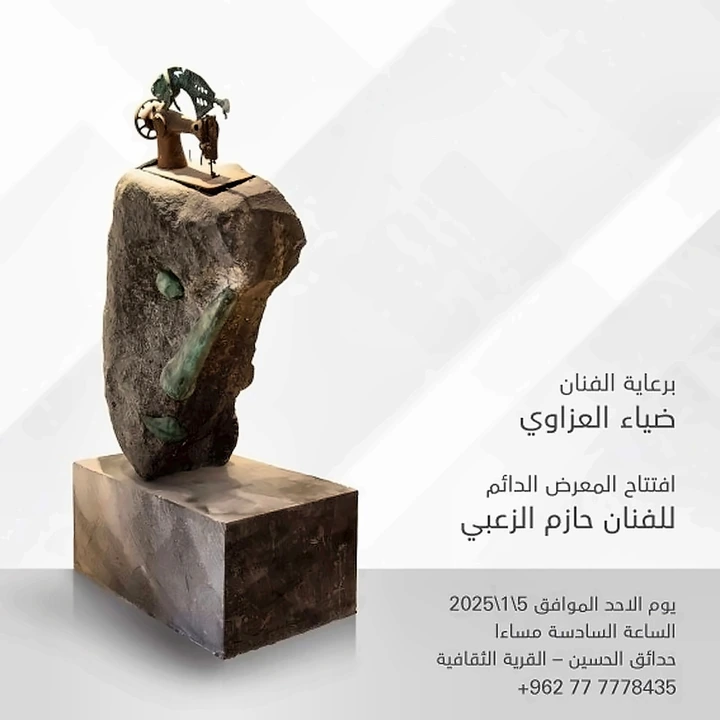
The printed invitation to the opening, in Arabic, naming Dia al-Azzawi as patron.
The document the timeline below is built from. Six in the evening, Sunday 5 January 2025. Al-Hussein Gardens Cultural Village.
The record

Forty-three years, in the order they happened.

1957
Born in Irbid, Jordan.
1977
Leaves building work in Irbid for Baghdad. Enrols at the Academy of Fine Arts to study cinematography and moves, in its workshops, to sculpture. His teachers: Saad Shaker in ceramics, Ismail Fattah in sculpture. Source: the artist, recorded 2026.
1979
Earliest dated work in the record — stoneware, 60 × 40 × 40 cm. Made during the Baghdad years, four years before his first exhibition.
1982
Graduates from the Academy of Fine Arts, Baghdad.
1983
First exhibition — a group show at Villa Rosa, Shmeisani, Amman, with Jim Peter and Jim Mason. Princess Fakhr al-Nisa buys his first plate. A shared studio in Shmeisani follows. Source: the artist, recorded 2026.
1986
First solo exhibition, Royal Cultural Centre, Amman.
1992–95
Washington D.C., Beirut, and the Sharjah International Biennial.
1993–2005
President of the Jordanian Association of Fine Artists.
1994
UNESCO Prize for Art and Creativity.
2000
The Jordan Pavilion, Expo 2000, Hanover. Work commissioned for the national pavilion of Jordan, laid out on a ninety-centimetre grid across an 1,800 m² floor. Made 1999. The pavilion was afterwards brought back to King Hussein Park, Amman.
2003–2027
Teaches ceramics at the School of Arts and Design, University of Jordan.
2004
State Appreciation Award, Jordan. Cairo International Biennale for Ceramics.
2014
أنشودة الطين · Song of Clay, Fann A Porter, Kempinski Hotel, Dubai. Opened by the Consul General of Jordan.
2015
Included in an exhibition of the students of Valentinos Charalambous.
2019
Objects of Imagination — Contemporary Arab Ceramics, Jordan National Gallery of Fine Arts, with Dia al-Azzawi, Ali Talib, Muhanna Durra and Wijdan.
2020
Permanent hall opens, InterContinental Jordan, Amman.
2023
Bronze and Stone Sculpture, Dar Al-Mashreq, Amman.
2025
Permanent sculpture hall opens at Al-Hussein Gardens Cultural Village, under the patronage of Dia al-Azzawi.
Collections

Jordan National Gallery of Fine Arts, Amman
Barjeel Art Foundation, Sharjah
Hindiyeh Museum of Arts, Amman

Awards

UNESCO Prize for Art and Creativity, 1994
State Appreciation Award, Jordan, 2004

Juries

State Appreciation Award for Ceramics and Sculpture, Kuwait — 2019 and 2021
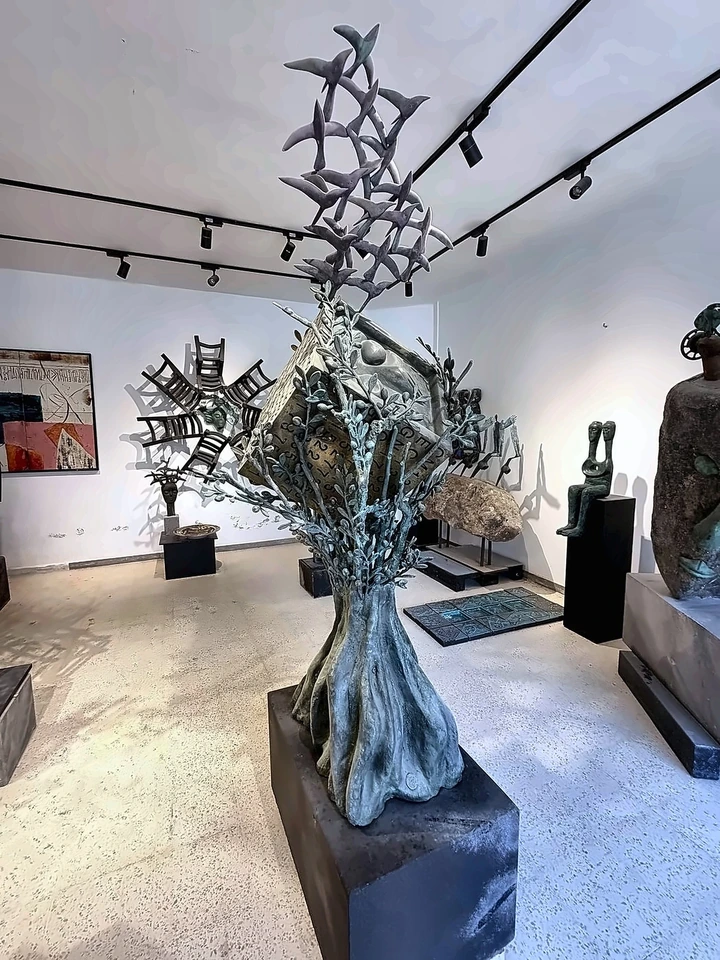
The permanent hall, the bronze olive tree at its centre.
Al-Hussein Gardens Cultural Village, Amman, 2025.
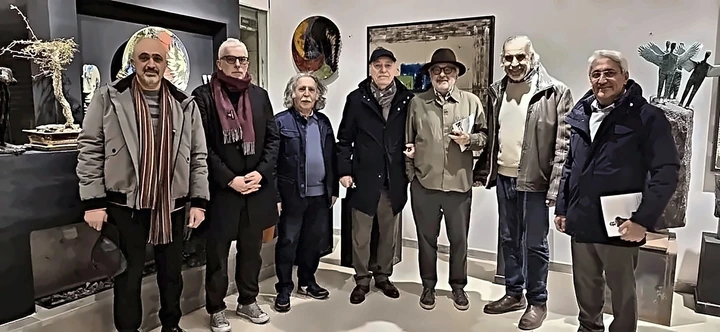
People standing among the sculptures on the opening night.
Opening night. 5 January 2025.
What has been written

The criticism exists. All of it is in Arabic.

A published academic study of his ceramics. Al Jazeera. Al-Dustour. Emarat Al Youm. Al-Watan in Muscat. Two national television programmes. Three museum collections, one of them the national gallery.

Not one line of it has ever been gathered in one place, and not one line of it has ever appeared in English. Which is why a curator in London who hears his name finds nothing, and concludes there is nothing.
Al-Dustour · 18 Sep 2023
Khaled Sameh on the Dar Al-Mashreq exhibition, carrying the critic Mohammad Al-Amiri's text: that Al-Zubi tests myth and the archaeological trace in contemporary form, and that having exhausted clay in its ceramic possibilities he moved to the more permanent nobility of stone and bronze.
Al Jazeera · May 2019
Covered among seventeen artists in حوار الحروف — Dialogue of Letters — for his use of letterform and ornamental structure across cosmic script, free writing and geometry.
Emarat Al Youm · 2014
A review of sculpture drawn from the Ain Ghazal statues, describing an artist bound to his environment, whose materials — clay, glass, bronze — all come from it.
Al-Watan, Oman · 2016
On خزف وألوان at Orfali Art Gallery, tracing his sources from Nabataean carving at Petra through Umayyad ornament to Jerash, Ajloun and Kerak.
Academic study · 2025
A published study of the influence of the Ain Ghazal statues on his contemporary ceramic work, arguing that it reinterprets heritage rather than illustrating it.
Roya TV · Helwa ya Donya
Television segments built around the artist and the Ain Ghazal statues.
Jordan National Gallery of Fine Arts
Holds four works: Inspiration from the Past, 1994 · Faces, 1999 · Untitled, 2005 · and a second Untitled. The museum describes glazed pieces with geometric divisions and stylised human, animal and calligraphic forms — primordial in air, modern in arrangement.
Barjeel Art Foundation, Sharjah
Holds Desert Design. One of the most significant collections of modern Arab art anywhere.
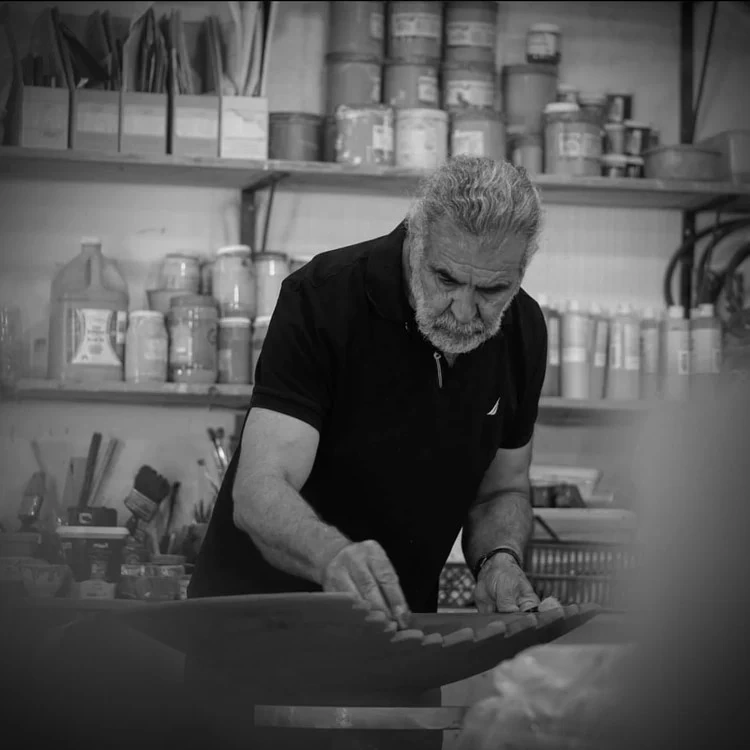
Hazem Al-Zubi at work in his studio, Amman.
At work in the studio. Amman.
What is still missing

The gaps are part of the record.

The dates of his association presidency are not fully resolved. One exhibition of the students of Valentinos Charalambous is recorded as 2015 in one source and 2013 in another. Whether he studied under Charalambous directly is highly likely and unpublished. None of it will be stated here until it can be sourced.

Museum records have been requested from the Jordan National Gallery of Fine Arts, the Barjeel Art Foundation and the Hindiyeh Museum of Arts. Foundry casting books are being sought. The archive grows as they arrive.

For curators, museums and press

Take the record with you.

Both documents carry an editor's note listing every correction, its basis, and every conflict still unresolved. Nothing in them is unsourced.

High-resolution press images are supplied on request with credit lines and caption text. Write to the studio.